
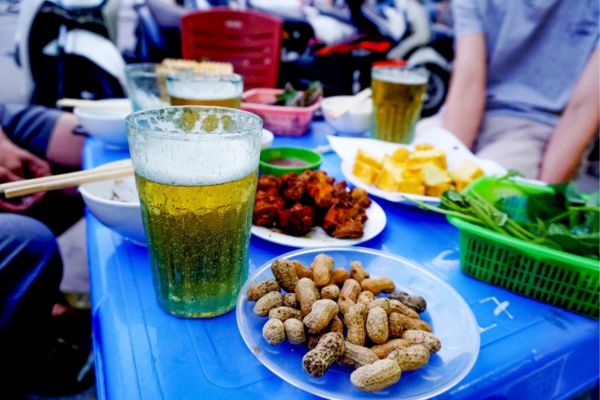
If you have spent more than a few hours wandering through the labyrinthine streets of the Old Quarter, you have undoubtedly seen it. On nearly every bustling corner, locals and travelers alike sit shoulder-to-shoulder on tiny plastic stools, gripping condensation-covered glass mugs filled with a pale, golden, foaming liquid. This is Bia Hoi – the undisputed king of Hanoi’s sidewalk culture.
As a local guide who has navigated these streets since well before 2010, I have introduced countless visitors to this legendary beverage. But Bia Hoi is much more than just a cheap, refreshing drink to combat the tropical heat. It is a historical artifact, a marvel of localized brewing, and a profound social equalizer. To truly appreciate what is in your glass, we have to travel back over a century to understand how beer arrived in Vietnam and how we made it entirely our own.
The French Connection: A 130-Year Brewing Legacy
The beer industry in Vietnam has a surprisingly deep history, dating back over 130 years. Similar to modern banking, journalism, and certain architectural styles, beer was introduced to Vietnam by the French in the late 19th century during their efforts to build modern urban centers, starting with Hanoi.
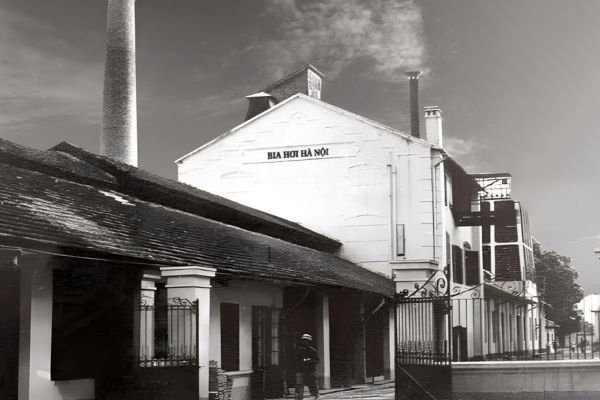
In 1890, an entrepreneur named Alfred Hommel laid the foundation for our modern beer culture by establishing the Hommel Brewery. He built this facility on a hill in Van Phuc village, Vinh Thuan district, Hanoi. Hommel acquired the majority of this hilly land in 1892, adding the remaining 6,900 square meters in 1896, and constructed solid buildings, a factory, and wine cellars.
In its early days, the brewery’s output was incredibly modest – producing just 150 liters per day with a workforce of 30 people. At this time, beer was a completely foreign concept to the local Vietnamese population; the product was almost exclusively consumed by French expatriates and civil servants. However, a 1907 report in the Bulletin économique de l’Indochine noted that Hommel Brewery had experienced unexpected growth and popularity, attributed to its affordable price and the exceptionally pure water used in production.
The Secret of the Underground Well
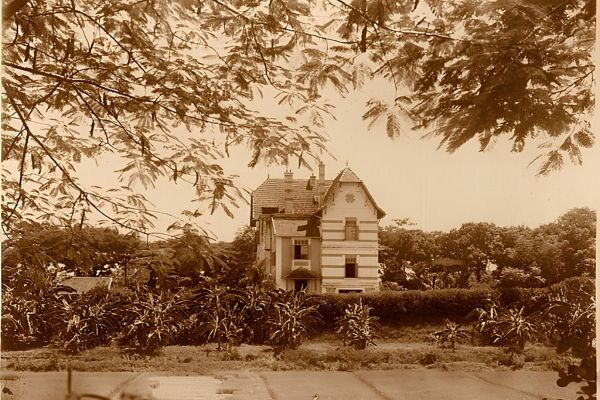
Water is the lifeblood of any good brewery. According to Patrice Hommel, the grandson of the founder, his grandfather often spoke of a subterranean well at the factory site that never ran dry. The water from this well was famously clear and sweet, which became the secret ingredient behind the renowned taste of the beer during that era. This well, along with the factory and residential quarters, was clearly marked on a property map from 1902. Today, the remnants of the Hommel Brewery, including the operator’s building where the Hommel family lived and a technical room situated on the old hill, are still preserved within the grounds of the modern Hanoi Beverage Corporation (Habeco).
From Hommel to Bia Hoi Hanoi
The brewery expanded rapidly. By 1911, it became a joint-stock company with a charter capital of 1,000,000 francs, employing 80 local workers from surrounding villages like Dai Yen, Lieu Giai, and Thuy Khue. Interestingly, unlike many other French enterprises in Hanoi at the time, Hommel Brewery employed no Chinese workers. Covering 4.25 hectares with 19 production workshops, the factory’s output soared to 7,000 hectoliters per year, securing a loyal customer base across Indochina and Yunnan, China. While hops were imported from the Bourgogne region of France, the factory began producing its own malt using barley imported from Yunnan.
In 1935, breweries across the region merged to form the Société de la Brasserie et Glacière de l’Indochine, and the Hommel workforce grew to 300 employees. A 1936 report to the Tonkin Resident Superior highlighted a massive cultural shift: despite challenges in importing raw materials, the industry thrived because the number of Vietnamese customers was steadily increasing. The French had successfully introduced beer to a population that, for centuries, had only known traditional rice liquor.
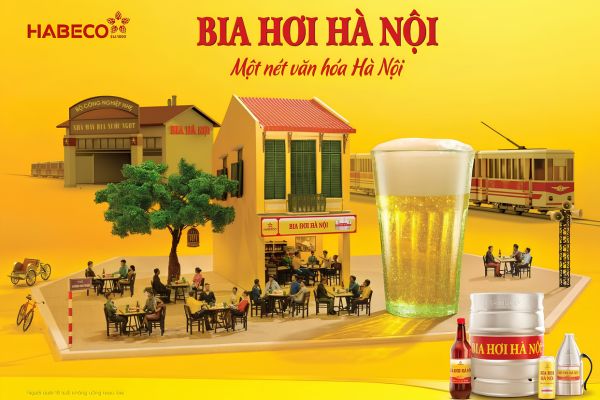
Following severe damage during the political upheaval in December 1946, the factory was rebuilt, achieving a production rate of 4,000 hectoliters per month with 350 workers (including 340 Vietnamese). When the French withdrew in 1954, they dismantled the machinery, leaving the site abandoned. However, in 1957, the Vietnamese government restored the factory, officially renaming it the Hanoi Brewery. This marked the true birth of the Bia Hoi we know and love today.
Decoding the Brew: Bia Hoi vs. Draft vs. Bottled
Many travelers are confused by the terminology used in Vietnam. You will see signs for Bia Tươi (Draft Beer), Bia Hơi (Fresh Beer), and standard canned or bottled beer. While all are fermented beverages made from water, malt, yeast, and hops, their production and serving methods dictate their distinct characters.
-
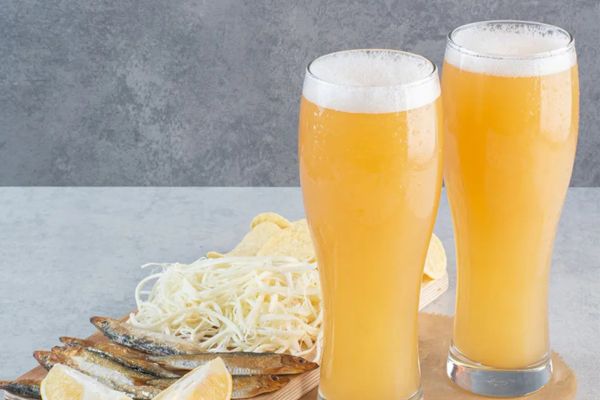
Bia Tươi (Traditional Draft Beer): Produced without any preservatives during the brewing and fermentation process. It is served directly after brewing and must be kept strictly chilled between 2°C and 4°C. If the temperature rises above 6°C for just two days, the beer will turn sour. To maintain peak flavor, high-end restaurants often brew it on-site and serve it in chilled glasses.
-
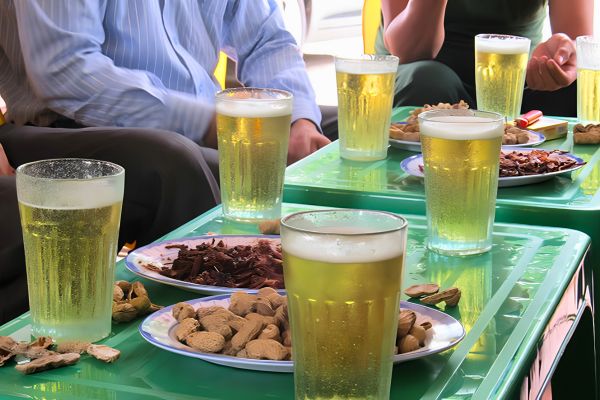
Bia Hơi (Fresh Beer): This is the beloved, low-alcohol street beer. It is brewed using a mix of wheat, corn, rice, and hops, with a very short fermentation period of just 7 to 10 days. It undergoes a rapid high-temperature flash pasteurization before being kegged. Because of this short process, it has a very brief shelf life and is meant to be consumed almost immediately.
-
Bottled and Canned Beer: These undergo a much longer fermentation process lasting 1 to 3 weeks. Before packaging, the beer is cold-stored, filtered through microbiological technology, and heat-pasteurized, allowing it to be preserved for up to 6 months. While convenient, they lack the raw, unadulterated freshness of kegged Bia Hoi.

(Note: If you see a commercial can labeled “Bia Hoi“, it is actually a pasteurized beer formulated to mimic the light taste of street beer, engineered to survive on a supermarket shelf!)
The Sidewalk Symphony
To drink Bia Hoi is to immerse yourself in the daily rhythm of Hanoi. You do not go to a quiet, dimly lit lounge to sip this brew. You go to a bustling intersection.
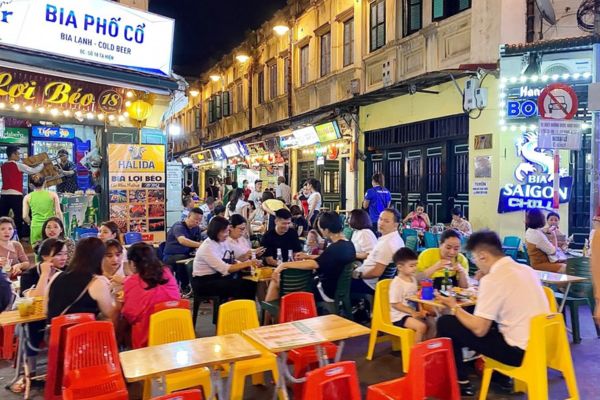
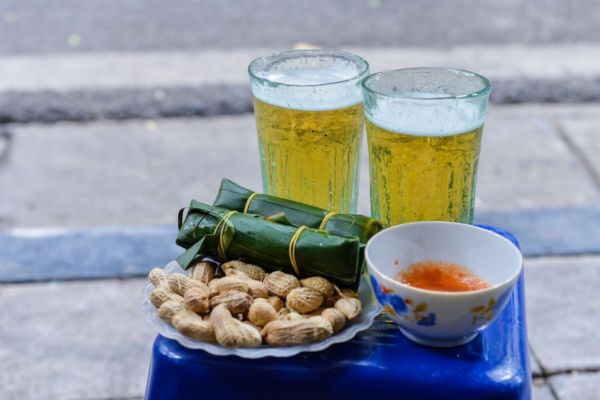
The ritual is simple. You take a seat on a plastic stool that barely elevates you off the pavement. The server drops a slightly chipped, distinctively green-tinted glass on your table, filled with a golden, bubbly liquid. You will likely order a plate of roasted peanuts, boiled quail eggs, or crispy fermented pork rolls (Nem Chua) to accompany your drink.
Around you, the city roars. Motorbikes weave through traffic, vendors push wooden carts full of fruit, and locals engage in loud, animated conversations. Then, you hear the universal chant of the Bia Hoi corner: “Một, Hai, Ba, Dô!” (One, Two, Three, Cheers!). Glasses clink, the cold beer washes away the humidity, and for a moment, the chaotic city makes perfect sense.
Bia Hoi is not just a drink; it is an institution. It is where businessmen in tailored suits sit next to construction workers in dusty boots, sharing the same space, the same air, and the same incredibly fresh beer. So, the next time you find yourself in Hanoi, skip the fancy cocktail bar for an afternoon. Find a crowded corner, pull up a plastic stool, and taste 130 years of history in a single glass.
